Sometimes People Just Need to Be Heard: What Science Says About Listening
 Muhammad Fikri Gunawan · · 7 min read

Advice is easy to give. Listening is harder and often worth more. Here is what research says about being heard, plus 7 simple habits to listen better.
Why do people sometimes just need to be heard?
Because feeling understood comes before problem solving. When someone talks about something painful, they often need room to sort out their thoughts and feelings, not a quick fix. Research on high-quality listening (attentive, empathic and nonjudgmental) suggests it lowers speakers' anxiety and defensiveness and helps them think more clearly about their own views. So the best first move is usually simple: listen, ask one open question, and offer advice only if they ask for it.
Most of us have been on both sides of this. You tell a friend you are exhausted at work and hear "just quit" or "have you tried a planner?" in return. The advice may be reasonable, yet you walk away feeling unheard. This article explains why that happens, what psychology says about listening, and seven habits that make you the person others actually want to talk to.
Why do we rush to give advice instead of listening?
Usually because we care. Watching someone we love struggle is uncomfortable, and advice feels like the fastest way to help. Silence can also feel awkward, so we fill it. The problem is the message advice can send when it arrives too early: "your feeling is a problem to be solved quickly." The other person may then stop explaining, defend their situation, or just say "thanks" and keep the real story to themselves.
Advice is not bad. Timing is the issue. Advice lands best after the person has been heard, and ideally after they have asked for it.
What did Carl Rogers teach about listening?

Carl Rogers (1902-1987) was an American psychologist who served as president of the American Psychological Association in 1947. He developed the person-centered approach to therapy, built on three conditions he believed help people grow: empathy, genuineness and unconditional positive regard. In 1957 he and Richard Farson published a short work called "Active Listening", written for people who are not therapists. Its central idea is that a good listener tries to see the world from the speaker's point of view instead of steering the speaker toward the listener's own.
What does research say about being listened to?
Listening research is younger than Rogers' ideas, but several studies point the same way:
- Less defensiveness. In a 2017 paper in Personality and Social Psychology Bulletin, psychologists Guy Itzchakov, Avraham Kluger and Dan Castro ran four laboratory experiments. Speakers who were listened to with high quality felt less social anxiety and processed information less defensively. They became more aware of the contradictions in their own attitudes and held less extreme views.
- Clearer thinking. A 2018 follow-up from the same research group found that high-quality listening led speakers to explore what they know about a topic more deeply, which increased attitude clarity. It did not make their views more correct, so being heard helps you see your own position more clearly, not automatically be right.
- Good listening is active, not silent. In a 2016 Harvard Business Review article, Jack Zenger and Joseph Folkman analyzed data on 3,492 participants in a development program for managers, rated by their colleagues. Great listeners did more than stay quiet: they engaged, for example by asking questions, and responded in ways that gave the speaker energy. The authors compare this to a trampoline rather than a sponge.
A caution: most of these studies are lab experiments or ratings of managers, so they show a pattern, not a guarantee. Still, they match what Rogers described almost seventy years ago and what many people notice in daily life.
How the Samaritans turned listening into a lifeline
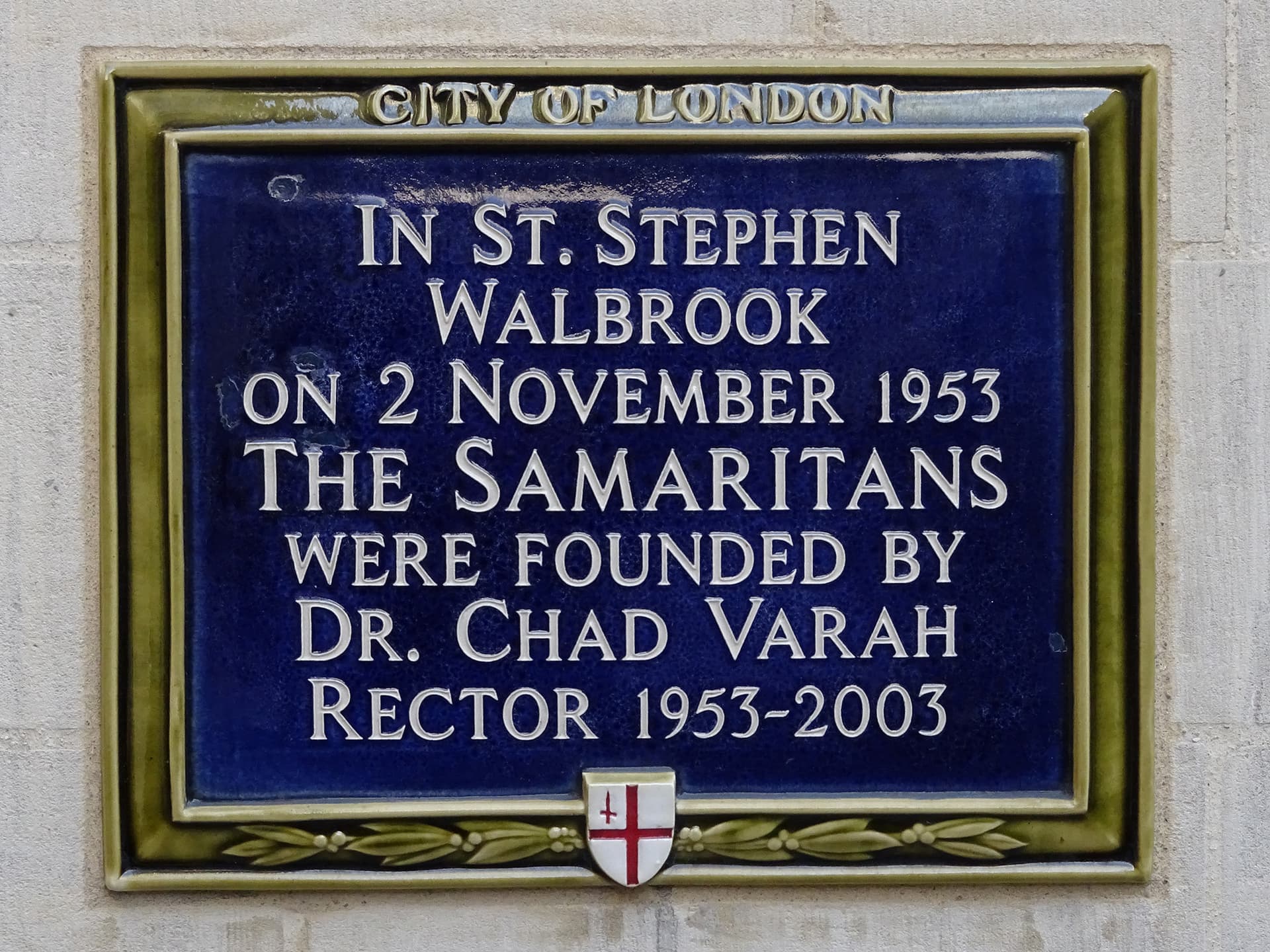
On 2 November 1953, Dr Chad Varah, then rector of St Stephen Walbrook in the City of London, founded the Samaritans, as the plaque on the church records. The charity grew into a listening service for people in distress. It still teaches the public a simple method called SHUSH, which it says is based on the skills of its volunteers:
- Show you care: give your full attention, make eye contact and put your phone away.
- Have patience: it can take time and several attempts before someone opens up.
- Use open questions: questions that cannot be answered with just yes or no.
- Say it back: repeat what you heard to check that you understood.
- Have courage: do not be afraid of silence or of difficult topics.
How to listen well: 7 habits you can start today
- Give your full attention. Put the phone face down, turn toward them and let the conversation be the only thing happening.
- Let them finish. Resist completing their sentences or jumping in with your own story. A pause often invites the most honest part.
- Ask open questions. Try "What has been the hardest part?" or "How did that feel?" instead of questions that can be answered with yes or no.
- Say it back. "So you felt ignored in that meeting, is that right?" Paraphrasing shows you are following and lets them correct you.
- Name the feeling, skip the fix. "That sounds exhausting" does more at this stage than a five-step plan.
- Ask before you advise. "Do you want ideas, or do you just want me to listen?" takes five seconds and prevents most mismatches.
- Be comfortable with silence. You do not have to fill every pause. Staying present is a message in itself.
What to say (and what to avoid) when someone just needs to be heard
Helpful phrases:
- "That sounds really hard."
- "Tell me more about it."
- "I'm here, take your time."
- "What would help most right now?"
Phrases that usually shut the conversation down:
- "Calm down."
- "At least it's not worse."
- "You should have..."
- "Everyone goes through this."
When listening is not enough
Listening is support, not treatment. If someone mentions harming themselves, being abused or being in danger, take it seriously: encourage them to contact a mental health professional or local emergency services, and stay with them while they do. The World Health Organization's psychological first aid guide for field workers, published in 2011 with War Trauma Foundation and World Vision International, sums up its approach in three steps: look, listen and link. Listening is the middle step, and the last one connects people with practical help and services.
Frequently asked questions
Why do some people just want to vent?
Talking out loud helps people organize their thoughts and release tension. Research on high-quality listening suggests that being heard calmly can reduce anxiety and defensiveness, which makes it easier to think clearly afterwards.
How can I tell if someone wants advice or just a listener?
Ask. "Do you want advice, or should I just listen?" removes the guesswork. If they are still describing what happened and how they feel, they are usually not ready for solutions yet.
Is listening really helping if I say almost nothing?
Good listening is not silent. Zenger and Folkman found that the best listeners engage, ask questions and reflect back what they hear. Attention plus a few well-chosen responses beats both silence and unsolicited advice.
How can I ask someone to listen to me?
Say what you need up front: "I don't need a solution right now, I just need you to listen for ten minutes." Most people are relieved to know what is expected of them.
Key takeaways
- Feeling heard usually comes before problem solving.
- Research links high-quality listening to lower anxiety, less defensiveness and clearer thinking.
- Good listening is active: attention, open questions and saying it back.
- Ask before you give advice.
- Listening is not a replacement for professional help when someone is at risk.
Sources and further reading
- Itzchakov, G., Kluger, A. N., and Castro, D. R. (2017). I Am Aware of My Inconsistencies but Can Tolerate Them: The Effect of High Quality Listening on Speakers' Attitude Ambivalence. Personality and Social Psychology Bulletin, 43(1).
- Zenger, J., and Folkman, J. (2016). What Great Listeners Actually Do. Harvard Business Review, 14 July 2016.
- Rogers, C. R., and Farson, R. E. (1957). Active Listening.
- Samaritans: SHUSH listening tips (samaritans.org/shush).
- World Health Organization, War Trauma Foundation and World Vision International (2011). Psychological first aid: Guide for field workers.