The Beatles Story: How Four Friends From Liverpool Changed Music Forever
 Muhammad Fikri Gunawan · · 10 min read
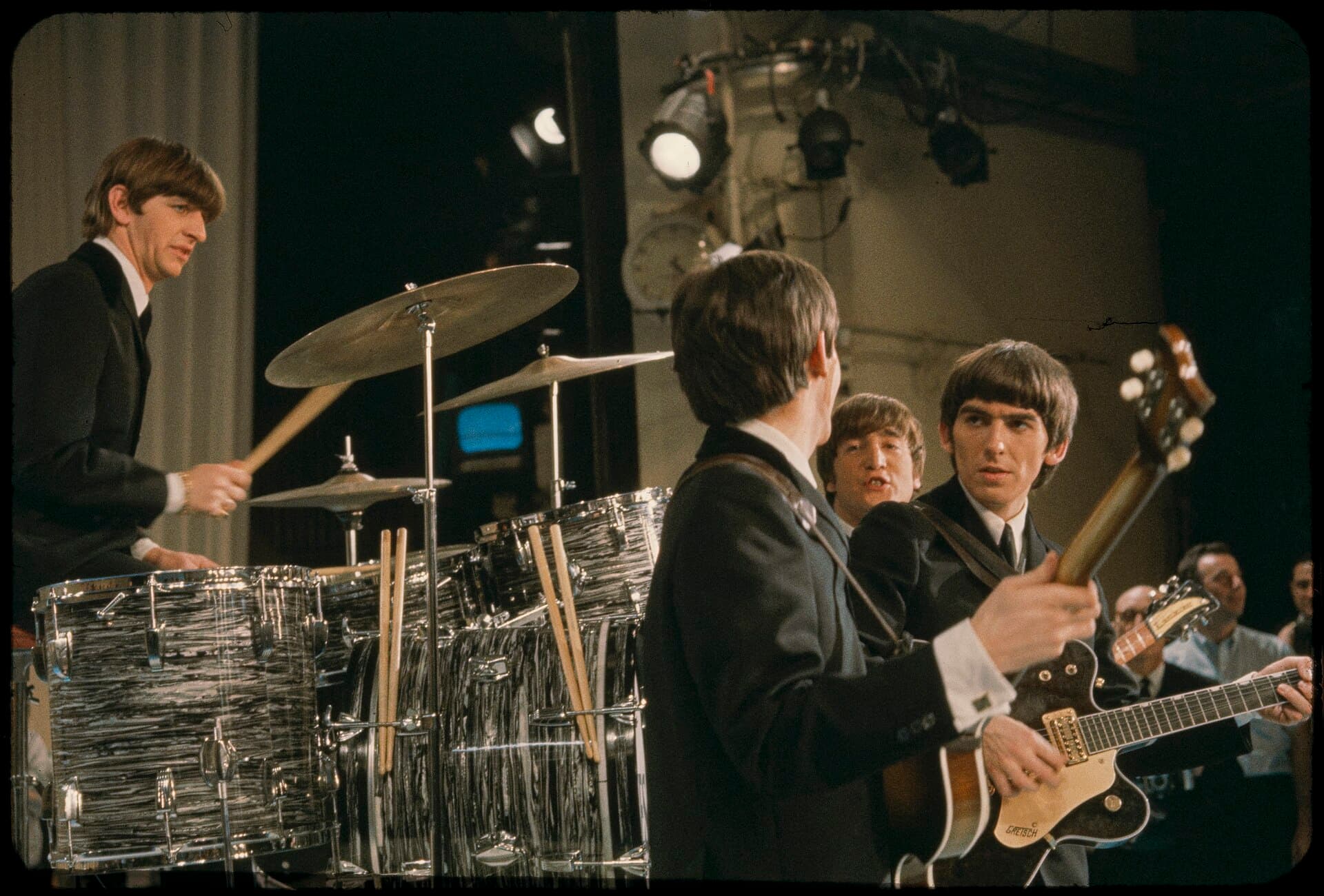
The Beatles (John Lennon, Paul McCartney, George Harrison and Ringo Starr) went from Liverpool clubs to a worldwide phenomenon in just eight years. Here is their story, biggest songs, records and legacy.
Quick answer: who were The Beatles?
The Beatles were an English rock band formed in Liverpool in 1960, made up of John Lennon, Paul McCartney, George Harrison and Ringo Starr. Between their first single, "Love Me Do" (1962), and their break-up in 1970, they released 12 studio albums in the UK and became the most influential band in pop history, with songs such as "Yesterday", "Hey Jude", "Let It Be" and "Come Together".
They changed what a pop group could be: they wrote most of their own songs, turned the recording studio into an instrument and made albums into complete artistic statements. This guide follows their story era by era, then covers their biggest songs, records and awards, and why they still matter.
Key takeaways
- The band grew out of Liverpool: Lennon met McCartney on 6 July 1957, Harrison joined in 1958 and Ringo Starr became the drummer in August 1962.
- Long club residencies in Hamburg and at Liverpool's Cavern Club built their stage skills, and manager Brian Epstein and producer George Martin turned them into recording stars.
- Beatlemania peaked in 1964: The Ed Sullivan Show on 9 February drew an estimated 73 million US viewers, and on 4 April they held the top five places on the Billboard Hot 100.
- They stopped touring after Candlestick Park on 29 August 1966 and became studio pioneers with Revolver and Sgt. Pepper's Lonely Hearts Club Band (1967).
- Abbey Road (1969) and Let It Be (1970) closed the story, and Paul McCartney announced his departure on 10 April 1970.
- Their legacy includes 20 Hot 100 number ones, the Rock and Roll Hall of Fame (1988) and a final song, "Now and Then", that won a Grammy in 2025.
The Beatles milestones at a glance
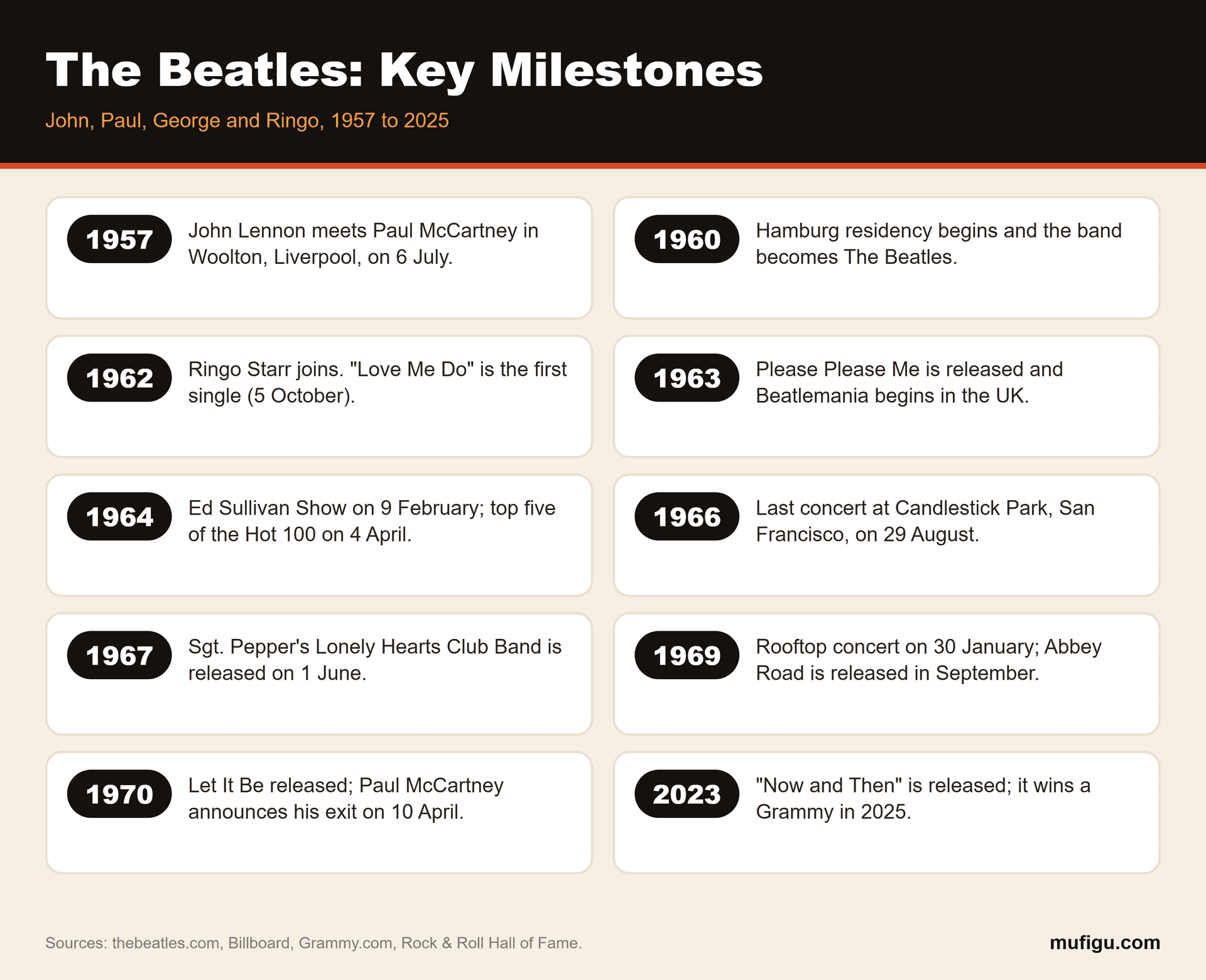
Liverpool beginnings: the Quarrymen and a church fête (1957–1960)
John Lennon formed a skiffle group called the Quarrymen in Liverpool in 1956. On 6 July 1957, at a church fête in Woolton, 15-year-old Paul McCartney met 16-year-old Lennon after seeing the band play. McCartney soon joined, and George Harrison followed in 1958.
The group went through several names, including Johnny and the Moondogs and the Silver Beetles, before settling on The Beatles in 1960. Stuart Sutcliffe played bass for a time, and Pete Best was the drummer until 1962.
Hamburg and the Cavern Club (1960–1962)
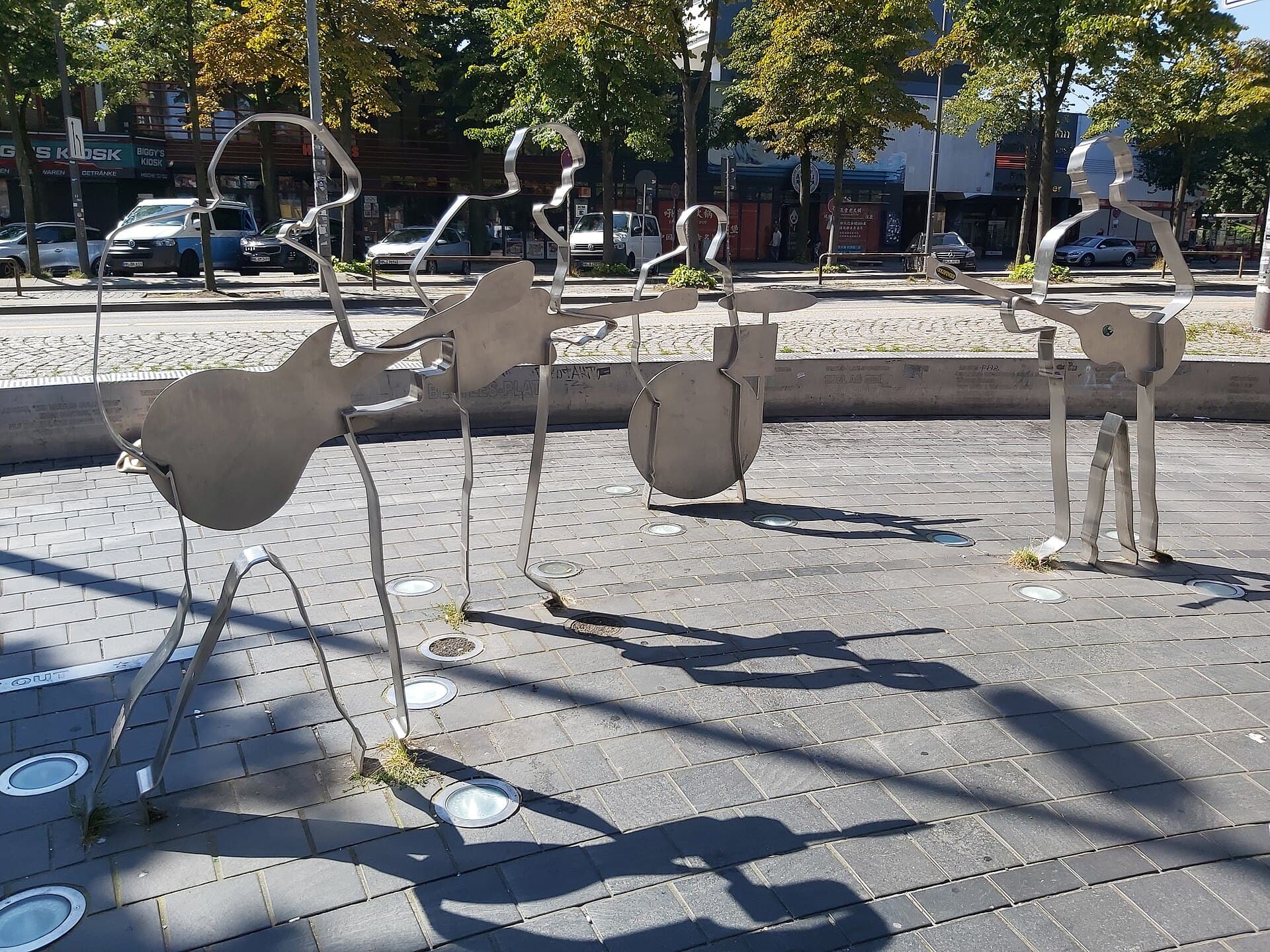
In August 1960 the band travelled to Hamburg, Germany, for the first of several long residencies in clubs in the St. Pauli district, playing for hours every night. The punishing schedule sharpened their stamina and stagecraft, and Hamburg's Beatles-Platz now honours that period with steel silhouettes of the four musicians.
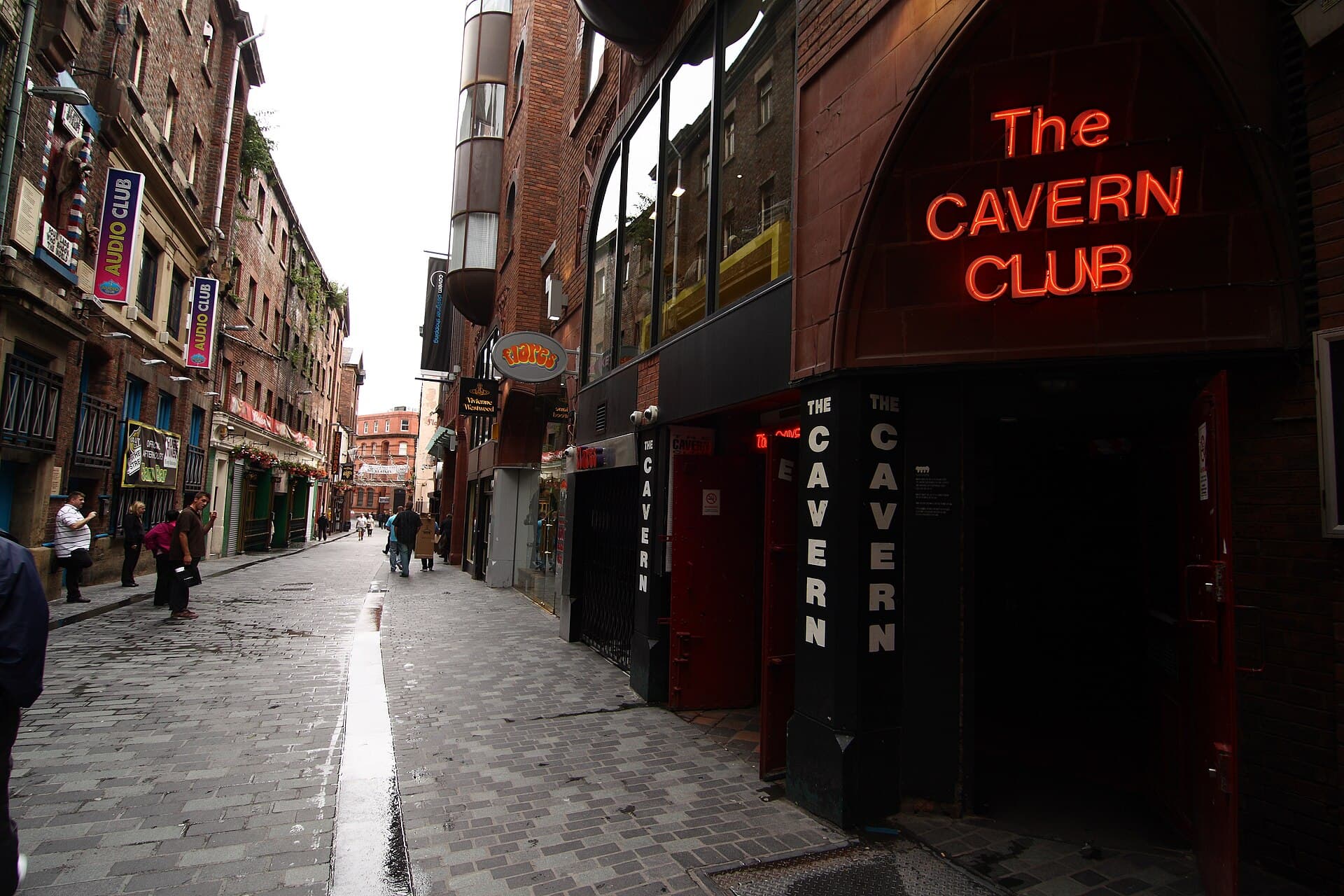
Back in Liverpool, they became regulars at the Cavern Club on Mathew Street. Brian Epstein, who managed a record store, first saw them there in November 1961 and soon became their manager. After Decca Records turned them down, producer George Martin signed them to EMI's Parlophone label in 1962.
The first hits (1962–1963)
In August 1962 Ringo Starr replaced Pete Best on drums, completing the line-up the world would know. Their first single, "Love Me Do", was released in the UK on 5 October 1962. Their debut album, Please Please Me, followed on 22 March 1963, and ten of its fourteen tracks were recorded in a single marathon session on 11 February 1963.
By the end of 1963, singles such as "From Me to You", "She Loves You" and "I Want to Hold Your Hand" had made them the biggest act in Britain, and the press began using the word Beatlemania.
Beatlemania and the conquest of America (1963–1965)
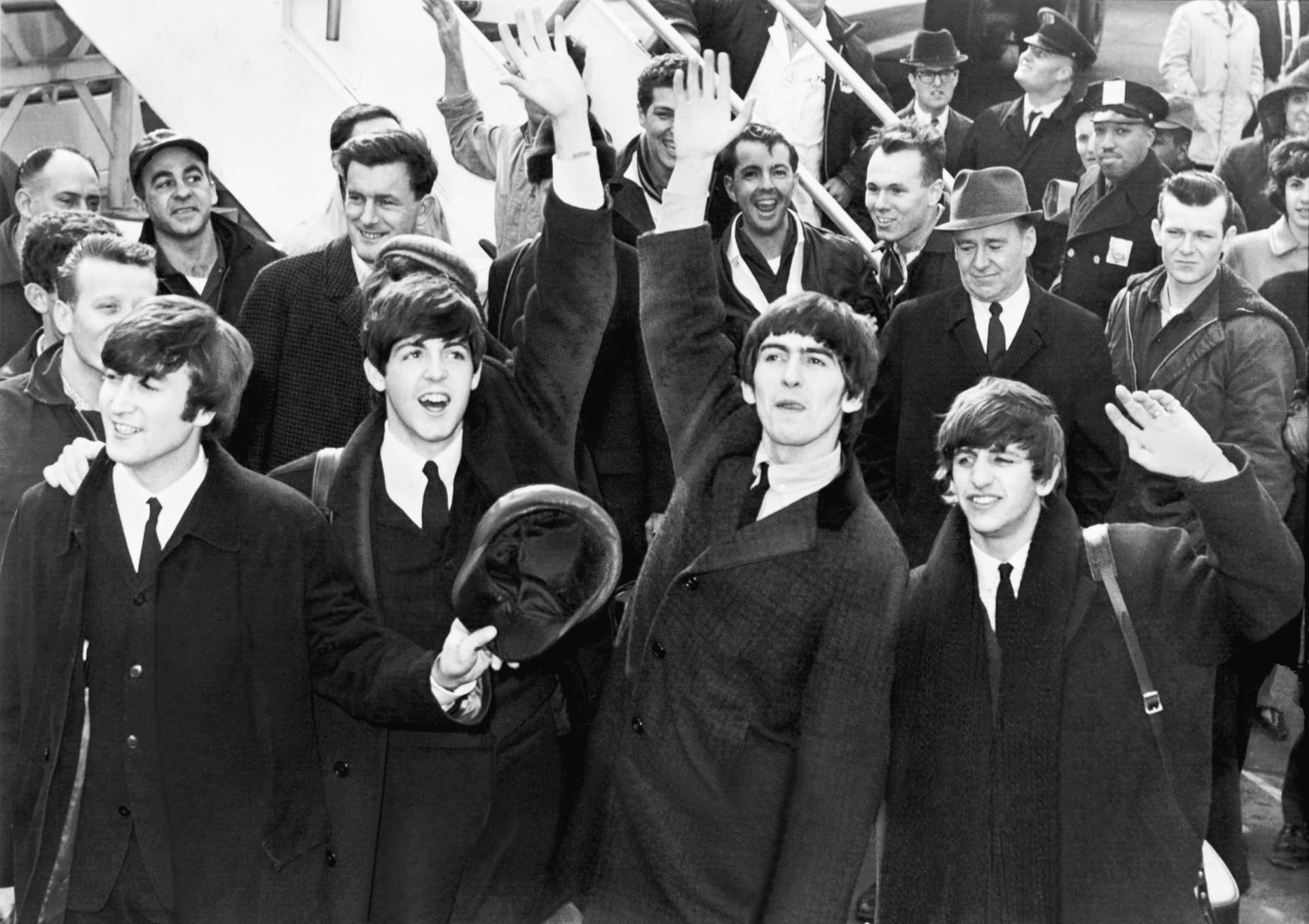
The Beatles landed at New York's John F. Kennedy Airport on 7 February 1964. Two days later, on 9 February, they played The Ed Sullivan Show, watched by an estimated 73 million Americans, a record for US television at the time.
On 4 April 1964 they held the top five positions on the Billboard Hot 100 at once, with "Can't Buy Me Love", "Twist and Shout", "She Loves You", "I Want to Hold Your Hand" and "Please Please Me". Billboard has described it as the first and only time an act has taken the whole top five, and they had twelve songs on the chart that week.
Films followed: A Hard Day's Night (1964) and Help! (1965). In 1965 all four received the MBE, and on 15 August they played Shea Stadium in New York, one of the first huge stadium rock concerts.
From touring band to studio pioneers (1965–1967)
By 1965 the music was growing up. Rubber Soul (December 1965) and Revolver (August 1966) brought sitars, tape loops, string arrangements and more personal lyrics. "Yesterday", "Eleanor Rigby" and "Tomorrow Never Knows" showed how far the band had moved from "Love Me Do".
Screaming crowds drowned out the music, and the band was tired of touring. Their last full public concert was at Candlestick Park in San Francisco on 29 August 1966.
They then poured their energy into the studio. Sgt. Pepper's Lonely Hearts Club Band, released on 1 June 1967, linked its songs into a single concept, used an orchestra on "A Day in the Life" and won the Grammy for Album of the Year in 1968.
Apple, the White Album and Abbey Road (1967–1969)
Brian Epstein died on 27 August 1967, and the band launched its own company, Apple Corps, in 1968. That year they released the double album The Beatles, known as the White Album, which ranges from rock to folk to experimental collage, along with the single "Hey Jude".
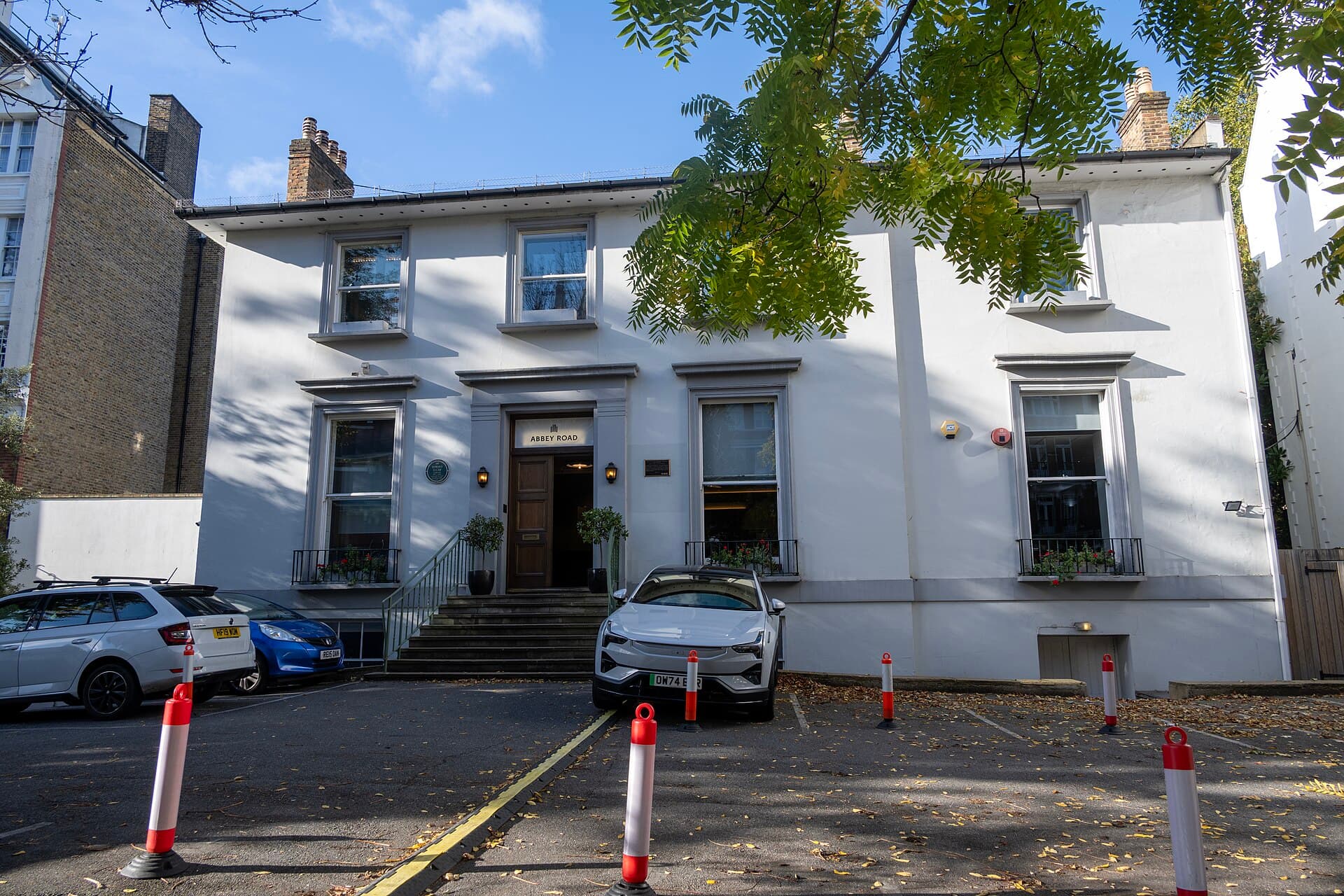
Most of their records were made at EMI's studios in St John's Wood, London, later renamed Abbey Road Studios after the album. On 30 January 1969 they gave their last public performance together, an unannounced rooftop concert on the Apple building at 3 Savile Row.
Abbey Road was released on 26 September 1969 and closes with a famous medley on side two. Its cover, photographed by Iain Macmillan on 8 August 1969, shows the four crossing the zebra crossing outside the studios.
Let It Be and the break-up (1969–1970)
Tensions over business and creative direction grew. The last album to be released, Let It Be (8 May 1970), was mostly recorded in January 1969, before Abbey Road, and later won the Oscar for Best Original Song Score.
On 10 April 1970 Paul McCartney announced he was leaving the group, and the band's partnership was formally dissolved in December 1974. The end was about people growing apart, with different musical ideas and a growing wish for independence, not a single dramatic event.
After the Beatles: solo careers and a last song
All four had successful solo careers. Lennon released Imagine (1971), McCartney formed Wings, Harrison issued the triple album All Things Must Pass (1970) and Starr scored hits such as "It Don't Come Easy". John Lennon was shot and killed in New York on 8 December 1980, and George Harrison died on 29 November 2001.
In the 1990s McCartney, Harrison and Starr completed two unreleased Lennon demos for the Anthology project, "Free as a Bird" (1995) and "Real Love" (1996). In 2021 Peter Jackson's documentary Get Back revisited the 1969 sessions. On 2 November 2023 the band released "Now and Then", which McCartney called the last Beatles song. It was built from a rough Lennon demo, using machine-learning technology to separate his voice from the piano, and it won Best Rock Performance at the Grammys in February 2025.
The Beatles' most famous songs
- "Love Me Do" (1962): their first single.
- "She Loves You" (1963): the "yeah, yeah, yeah" hit that fuelled Beatlemania.
- "I Want to Hold Your Hand" (1963): their first US number one.
- "Yesterday" (1965): a McCartney ballad with a string quartet, one of the most recorded songs ever.
- "Strawberry Fields Forever" and "Penny Lane" (1967): a double A-side inspired by places in Liverpool.
- "A Day in the Life" (1967): the orchestral finale of Sgt. Pepper.
- "Hey Jude" (1968): over seven minutes long and nine weeks at number one in the US.
- "Come Together" (1969): the opening track of Abbey Road, written by Lennon.
- "Here Comes the Sun" (1969): a Harrison song from Abbey Road.
- "Let It Be" (1970): a McCartney anthem and the title track of their final album.
Records, awards and rankings
- 20 number-one hits on the Billboard Hot 100, the most of any act, according to Guinness World Records.
- The top five places on the Hot 100 at the same time, on 4 April 1964.
- Grammy for Album of the Year for Sgt. Pepper's Lonely Hearts Club Band (1968).
- Oscar for Best Original Song Score for Let It Be.
- Inducted into the Rock and Roll Hall of Fame in 1988 and given a Grammy Lifetime Achievement Award in 2014.
- Grammy for Best Rock Performance for "Now and Then" in 2025, their first Grammy win since 1997.
- Paul McCartney was knighted in 1997 and Ringo Starr in 2018.
Legacy: Liverpool, Abbey Road and a catalogue that never aged
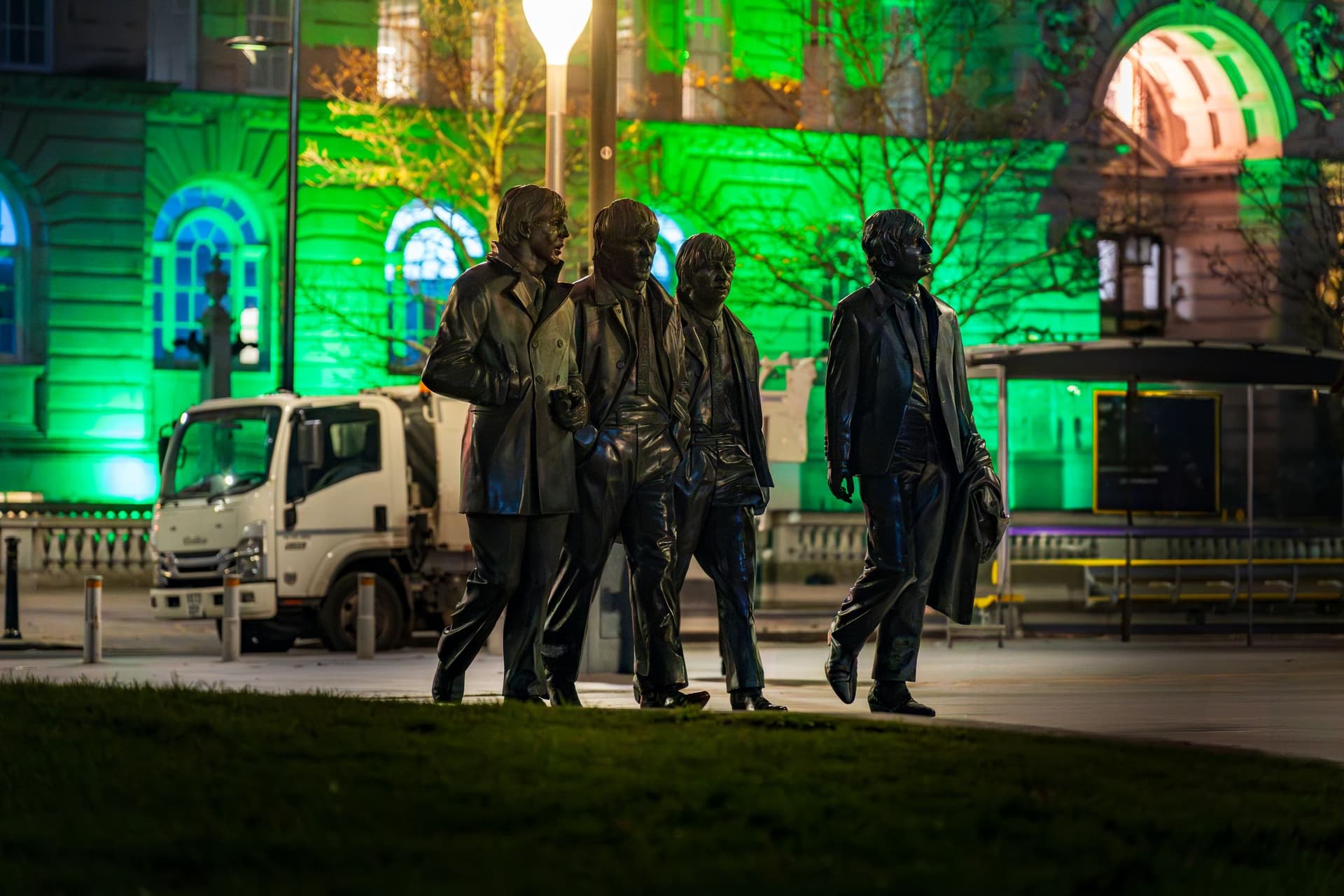
Liverpool still lives on the band: the Cavern Club, Penny Lane, Strawberry Field and the bronze statue at Pier Head draw visitors from around the world. In London, the zebra crossing outside Abbey Road Studios was given Grade II listed status in 2010 and remains one of the city's most photographed spots.
Musically, their influence is everywhere: writing your own songs, using the studio creatively, releasing albums as complete works and treating pop as art. In Indonesia, groups such as Koes Bersaudara, later Koes Plus, were among those influenced by the British Invasion that The Beatles led. New listeners keep arriving through streaming, remastered editions and documentaries.
Frequently asked questions
Who were The Beatles?
The Beatles were an English rock band from Liverpool, active from 1960 to 1970. They are widely regarded as the most influential band in popular music.
Who were the members of The Beatles?
John Lennon (1940–1980), Paul McCartney, George Harrison (1943–2001) and Ringo Starr. Stuart Sutcliffe and Pete Best were members in the early years.
What was The Beatles' first single?
"Love Me Do", released in the UK on 5 October 1962. Their first album, Please Please Me, came out on 22 March 1963.
When and why did The Beatles break up?
Paul McCartney announced he was leaving on 10 April 1970. The split followed business disputes and diverging creative interests, and the partnership was formally dissolved in December 1974.
How many albums did The Beatles release?
Twelve studio albums in the UK between 1963 and 1970, from Please Please Me to Let It Be, plus singles, EPs and later compilations.
What was the last Beatles song?
"Now and Then", released on 2 November 2023. It was completed from a rough John Lennon demo and won a Grammy for Best Rock Performance in 2025.
Which Beatles album is considered the best?
Critics often point to Revolver, Sgt. Pepper's Lonely Hearts Club Band and Abbey Road, though Rubber Soul and the White Album also appear on many best-of lists. It is a matter of taste.
Final thoughts
Nearly sixty years after their last concert, The Beatles still sound alive. From a skiffle group at a church fête to the Cavern Club, Ed Sullivan's stage and the studios of Abbey Road, four friends from Liverpool rewrote the rules of popular music in just eight years of recording. If you are new to them, start with a playlist of the songs above, then listen to Revolver and Abbey Road from beginning to end.