Atomic Habits by James Clear: Summary of the 4 Laws of Behavior Change
 Muhammad Fikri Gunawan · · 4 min read
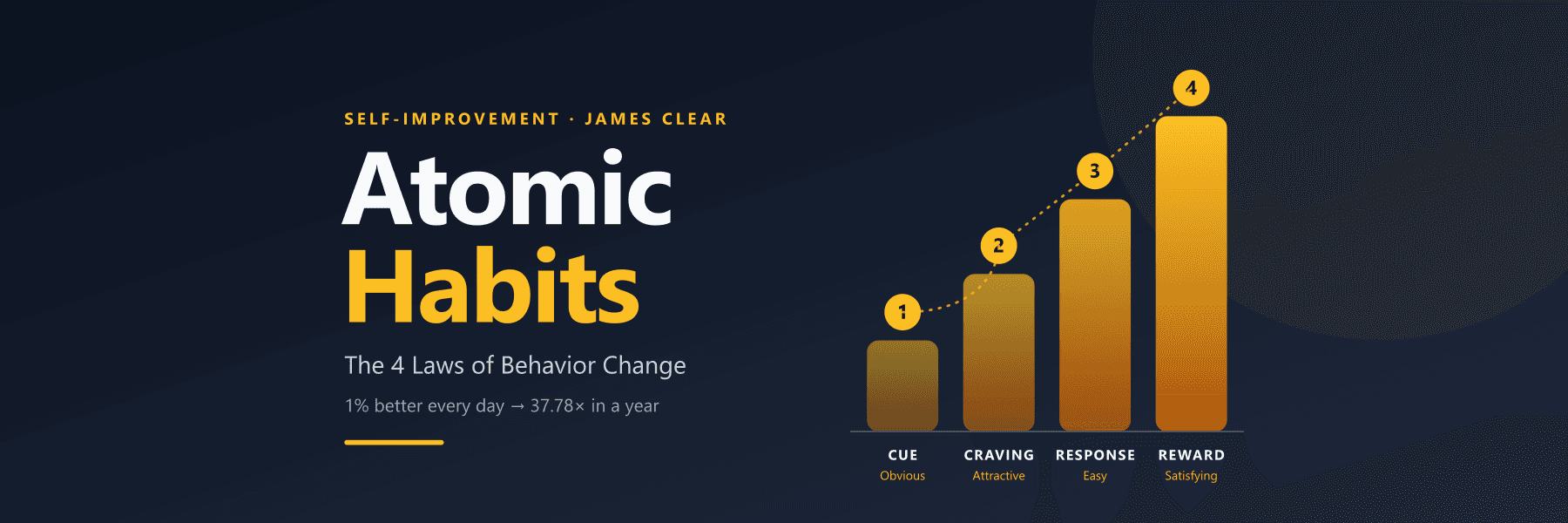
A summary of James Clear's Atomic Habits: the 4 laws of behavior change (Cue, Craving, Response, Reward), how to build good habits, and how to break bad ones.
Atomic Habits is a self-improvement book by James Clear about building good habits and breaking bad ones through small, consistent changes. The idea is simple: if you get 1% better every day, you will be 37.78 times better after one year. Small habits don't just add up, they compound.
Core Idea: Focus on Systems, Not Goals
"Success is the product of daily habits, not once-in-a-lifetime transformations." According to James Clear, bad habits repeat themselves again and again not because you don't want to change, but because you have the wrong system to change.
- Outcomes: what you want to achieve.
- Processes: the system and steps you follow.
- Identity: who you are. Build identity-based habits instead of outcome-based habits.
What Is the Habit Loop and the 4 Laws of Behavior Change?
The habit loop is a four-step cycle behind every habit: Cue, Craving, Response, and Reward. From this loop come the 4 laws of behavior change: make it obvious, make it attractive, make it easy, and make it satisfying.
Law 1: Make It Obvious
- Make a list of your daily habits so you become aware of what you actually do.
- Habit stacking: attach a new habit to an existing one. Use the format: "After ______, I will ______."
- Environment design: shape your surroundings so good habits are easier to do. For example, leave the guitar in the middle of the room if you want to practice. One space, one use.
Law 2: Make It Attractive
- Temptation bundling: pair something you need to do with something you enjoy. For example, run while watching Netflix.
- We imitate the people around us: the close, the many, and the powerful. Join a culture where the desired behavior is the normal behavior.
- Motivation ritual: do a small ritual before you start to get ready mentally. For example, make a cup of coffee, then press play.
Law 3: Make It Easy
- Repetition, not perfection: habits are formed by frequency, not time.
- Reduce friction: prime your environment for future use so there is no friction and a new habit doesn't feel like a challenge.
- The 2-minute rule: when you start a habit, it should take less than 2 minutes.
- Automate: whenever you can, automate good habits. For example, set up automatic payments or transfers.
Law 4: Make It Satisfying
- Immediate satisfaction: add a little bit of immediate pleasure to habits that pay off in the long run. What is rewarded is repeated, what is punished is avoided.
- Personal loyalty program: whenever you pass on a purchase, put the same amount of money into your savings account.
- Habit tracker: measure your progress, and automate it whenever possible. Beware of Goodhart's Law: when a measure becomes a target, it ceases to be a good measure.
How Do You Break a Bad Habit?
Invert the 4 laws above:
- Reduce exposure (make it invisible): cut down exposure to the cue that causes a bad habit.
- Reframe mindset (make it unattractive): highlight the benefits of avoiding your bad habit.
- Increase friction (make it difficult): increase the number of steps between you and your bad habit.
- Create a contract (make it unsatisfying): make the costs of your bad habits public and painful.
Conclusion
Behavior change is a continuous process with no finish line. Small habits don't add up, they compound. Make habits enjoyable and fall in love with boredom.
Frequently Asked Questions (FAQ)
What are the 4 laws of behavior change in Atomic Habits?
They are: make it obvious (Cue), make it attractive (Craving), make it easy (Response), and make it satisfying (Reward).
What is the 2-minute rule?
The 2-minute rule means shrinking a new habit until it can be started and finished in under 2 minutes, so it is easy to begin and easy to repeat consistently.
What is habit stacking?
Habit stacking means attaching a new habit to an existing one, using the format: "After ______, I will ______."
How do you break a bad habit according to James Clear?
Invert the 4 laws: reduce exposure to the cue, reframe your mindset, increase friction, and create a contract that makes the bad habit costly.